We’re talking education that builds the future
Eligibility | Fees and Financial Assistance | Facts & Figures| HOD Message| Faculty |Board of Studies| Departmental Committees | Announcement | MoUs | Syllabus | Open Electives | Time Tables | UG with Honours | Additional Minor Engineering | Value Added Courses | Internships | Research | Infrastructure | Documents | Events
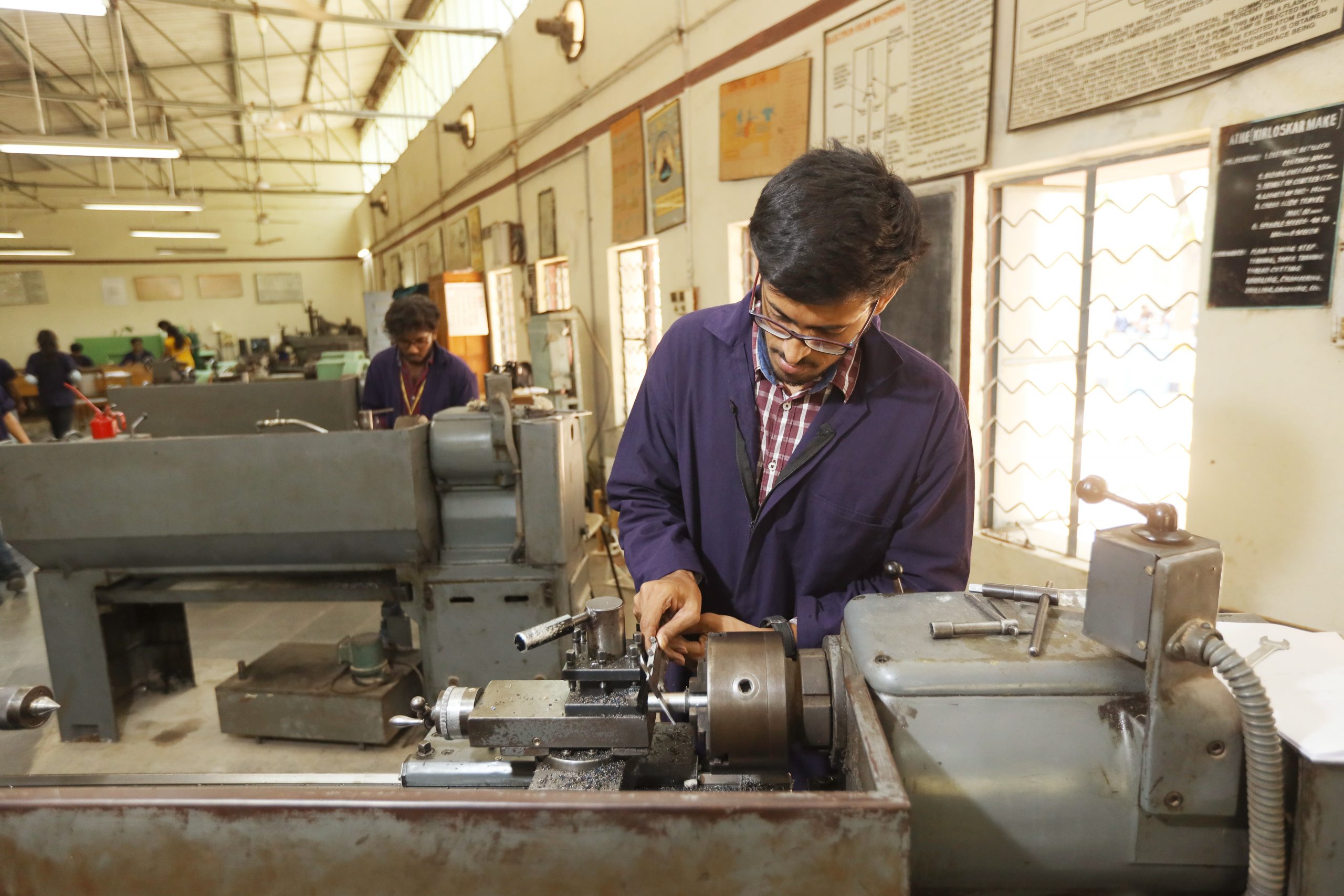
The mechanical engineering department at CBIT always strives to stay at the forefront of technological innovation. Our department lives and swears by technological developments that are shaking the very foundations of conventional wisdom. If there is an existing solution to a real life problem in the field of mechanical engineering, our students know of it. And if there doesn’t exist any, you can find them engrossed in finding one.
UG
PG
To be the destination for aspiring young minds to become globally competitive,enlightened, innovative, immediate contributors to the industry and successful in higher studies in the field of mechanical engineering.
1.To impart quality and innovative education in mechanical engineering with basic and specialised training, internships to meet the current and emerging needs of the industry.
2.To prepare the students for successful professional career by inculcating ethical, entrepreneurial and leadership qualities.
3.To foster Research and Development environment by disseminating knowledge and technology by involving the students in publications, sponsored projects and consultancy.
After Four years of graduation graduates will have
The graduates will be able to
Engineering Knowledge:
Apply the knowledge of mathematics, science, engineering fundamentals, and an engineering specialization for the solution of complex engineering problems
Problem analysis:
Identify, formulate, research literature, and analyse complex engineering problems reaching substantiated conclusions using first principles of mathematics, natural sciences, and engineering sciences.
Design/development of solutions:
Design solutions for complex engineering problems and design system components or processes that meet the specified needs with appropriate consideration for public health and safety, and cultural, societal, and environmental considerations.
Conduct investigations of complex problems:
Use research-based knowledge and research methods including design of experiments, analysis and interpretation of data, and synthesis of the information to provide valid conclusions.
Modern tool usage:
Create, select, and apply appropriate techniques, resources, and modern engineering and IT tools, including prediction and modelling to complex engineering activities, with an understanding of the limitations.
The engineer and society:
Apply reasoning informed by the contextual knowledge to assess societal health, safety, legal, and cultural issues and the consequent responsibilities relevant to the professional engineering practice.
Environment and sustainability:
Understand the impact of the professional engineering solutions in societal and environmental contexts, and demonstrate the knowledge of and need for sustainable development.
Ethics:
Apply ethical principles and commit to professional ethics and responsibilities and norms of the engineering practice.
Individual and team work:
Function effectively as an individual, and as a member or leader in diverse teams, and in multidisciplinary settings.
Communication:
Communicate effectively on complex engineering activities with the engineering community and with the society at large, such as, being able to comprehend and write effective reports and design documentation, make effective presentations, and give and receive clear instructions.
Project management and finance:
Demonstrate knowledge and understanding of the engineering and management principles and apply these to one’s own work, as a member and leader in a team, to manage projects and in multidisciplinary environments.
Life-long learning:
Recognize the need for, and have the preparation and ability to engage in independent and life-long learning in the broadest context of technological change.